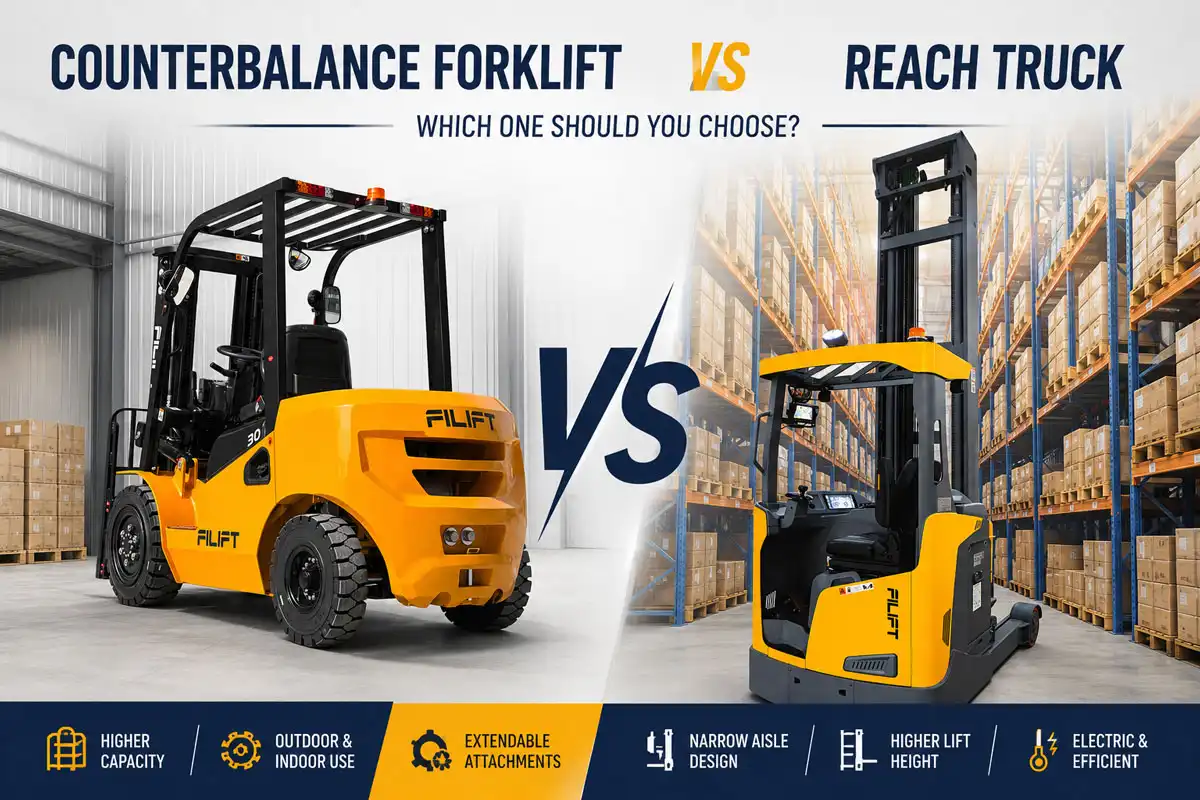
Counterbalance Forklift vs Reach Truck: Differences, Advantages and How to Choose
When selecting a forklift for material handling operations, one of the most common questions is whether to choose a counterbalance forklift or a reach truck.
Although both machines are designed to lift and transport pallets, they are built for different working environments. Counterbalance forklifts are known for their versatility and high load capacity, while reach trucks are designed for efficient operation in narrow aisles and high-rise warehouses.
Choosing the right forklift depends on factors such as warehouse layout, aisle width, lifting height, load capacity, and operating environment.
This guide will explain the differences between counterbalance forklifts and reach trucks and help you determine which one is the best choice for your application.
1. What Is a Counterbalance Forklift?
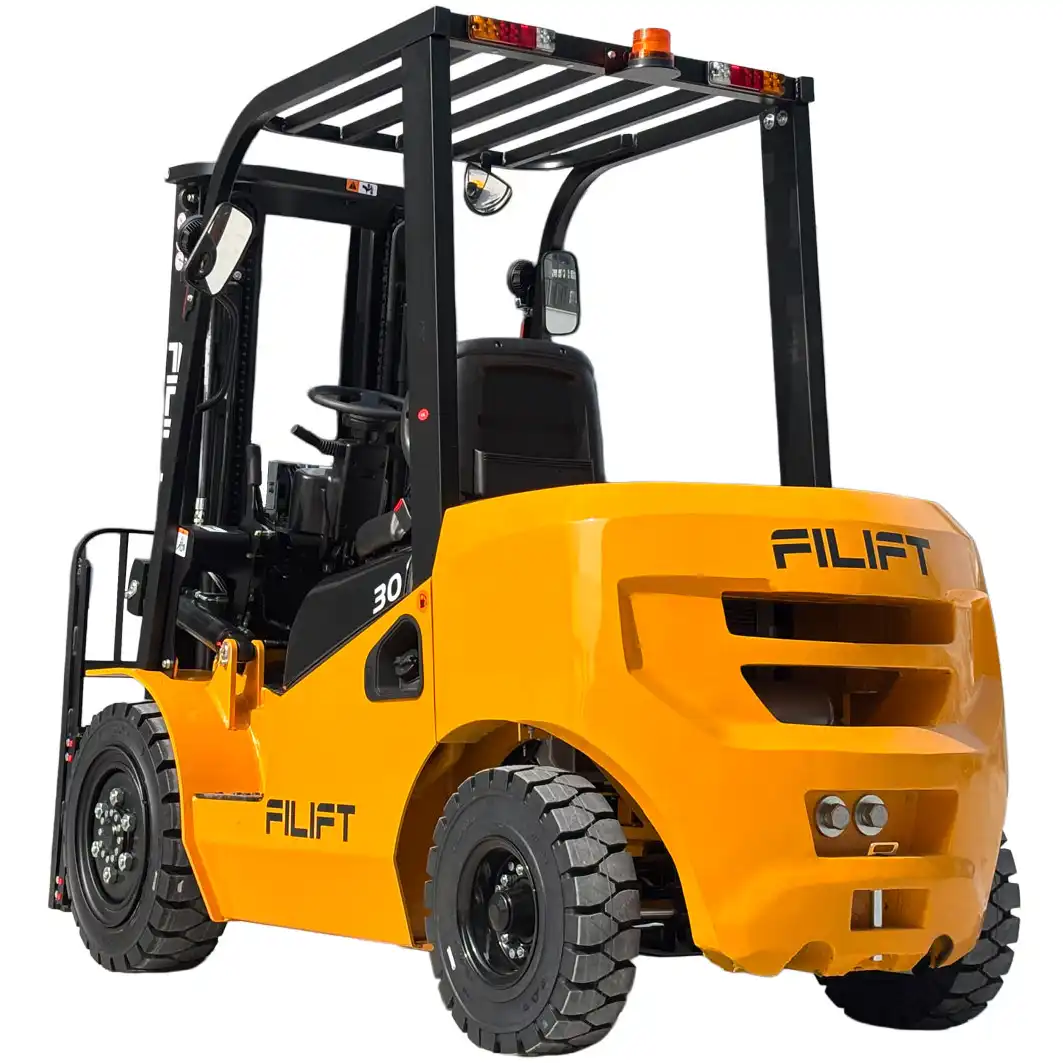
A counterbalance forklift is the most common type of forklift used in material handling. It uses a heavy counterweight at the rear of the truck to balance the load lifted by the forks.
Unlike warehouse trucks that require support legs, counterbalance forklifts can drive directly up to pallets and lift loads without additional support. This makes them highly flexible for loading and unloading trucks, transporting materials, and handling pallets in various environments.
Counterbalance forklifts are available with different classifications, including:
·Internal Combustion Forklift – suitable for outdoor and heavy-duty applications
·Electric Forklift – ideal for clean indoor environments
Counterbalance forklifts usually offer higher load capacities, ranging from small warehouse models to heavy-duty machines exceeding 10 tons.
2. What Is a Reach Truck?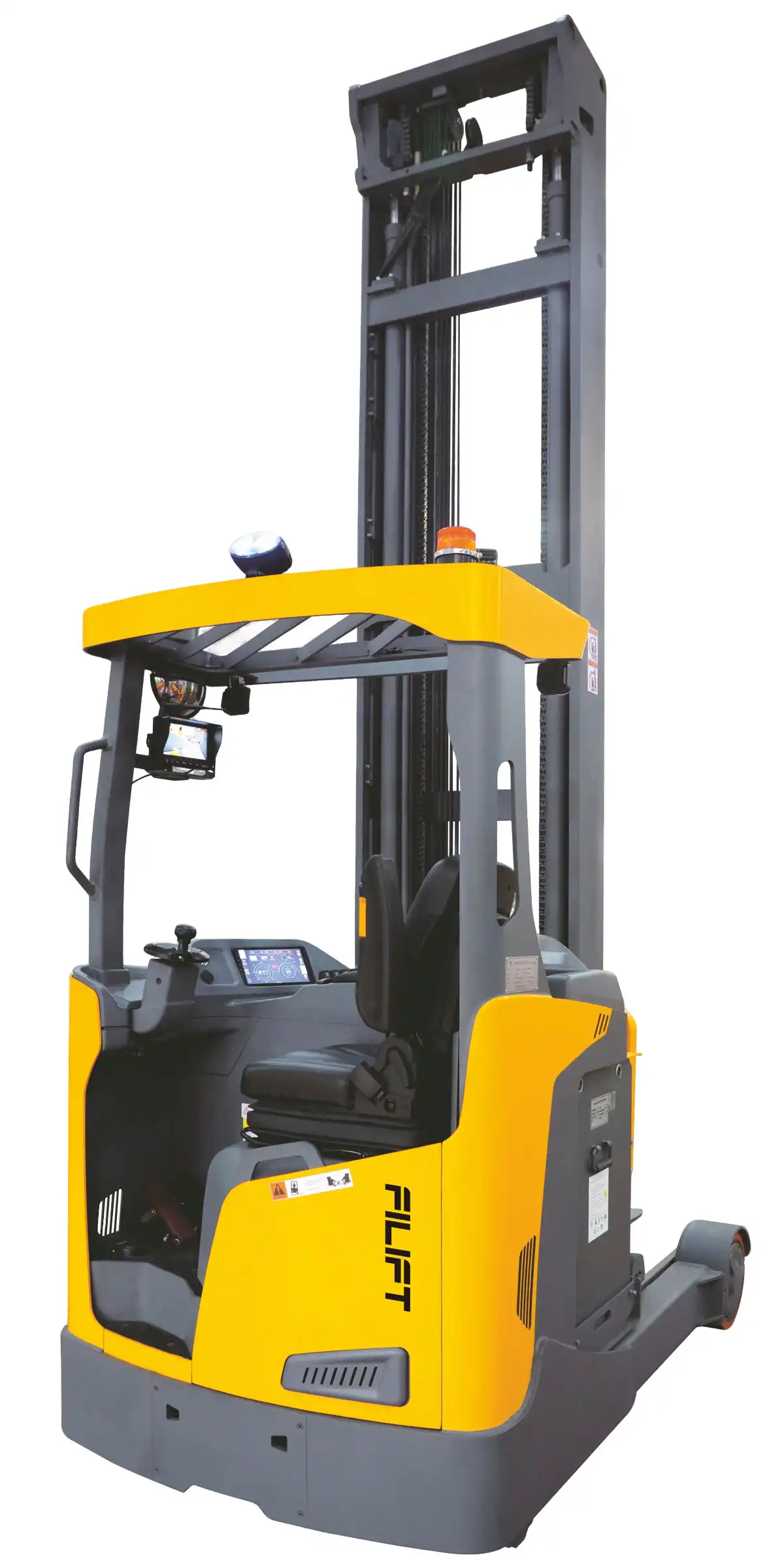
A reach truck is an electric warehouse forklift specifically designed for high-density storage systems and narrow aisles.
The biggest difference between a reach truck and a counterbalance forklift is the reach mechanism. Pls click here for more details.
This design allows reach trucks to:
·Operate in much narrower aisles
·Reach higher storage positions
·Maximize warehouse space utilization
Most reach trucks have lifting capacities between 1.5 and 2.5 tons, with lifting heights commonly exceeding 8 meters and some models reaching over 14 meters.
3. Counterbalance Forklift vs Reach Truck: Key Differences
| Feature | Counterbalance Forklift | Reach Truck |
| Fork movement | Fixed forks; optional fork extensions can be installed | Forks move forward and backward through reach mechanism |
| Attachments | side shifter, fork positioner, clamps, rotators, and more | Usually limited to side shifter |
| Aisle width requirement | Usually > 4 m | Usually < 3 m |
| Load capacity | 1–50+ tons | 1.5–2.5 tons |
| Lift height | 3-6 m | 7-14 m |
| Power options | Electric, LPG, diesel | Electric |
| Operating environment | Indoor and outdoor use | Mainly indoor use |
| Maneuverability | More suitable for open spaces and yards | Optimized for warehouse aisles |
| Tire type | Pneumatic or solid tires | Cushion tires or polyurethane tires |
| Initial cost | Lower purchase cost for similar capacity | Higher initial investment |
| Operating cost | Higher fuel and maintenance cost for IC models | Lower energy and maintenance cost |
4. Why Choose a Counterbalance Forklift?
1). You Need Higher Load Capacity
If your operation involves heavy pallets, steel products, machinery parts, or bulk materials, a counterbalance forklift provides much higher lifting capacity, from 3 tons to even 50 tons.
Reach trucks are mainly designed for warehouse pallets and are not suitable for heavy-duty applications.
2). You Need Outdoor Operation
Counterbalance forklifts are available with:
·Pneumatic tires for uneven surfaces
·Diesel engines for outdoor environments
·Weather-resistant designs
They are commonly used for:
·Loading and unloading containers
·Moving materials between buildings
·Outdoor storage yards
Reach trucks, on the other hand, are mainly designed for smooth indoor floors.
3). You Need Various Attachments
One major advantage of counterbalance forklifts is their attachment compatibility.
Common attachments include:
·Side shifter
·Fork positioner
·Paper roll clamp
·Bale clamp
·Rotator
·Drum clamp
These attachments allow one forklift to handle different types of materials.
5. Why Choose a Reach Truck?
1). You Have Narrow Aisles
Reach trucks can operate in aisles much narrower than traditional counterbalance forklifts.
A typical reach truck may work in aisles around 2.5–3 meters, while counterbalance forklifts usually require wider aisles.
This allows warehouses to install more storage racks and increase storage density.
2). You Need High Lifting Heights
Reach trucks are designed for vertical storage.
Their advanced mast systems allow operators to place pallets at very high rack levels while maintaining stability.
They are commonly used in:
·High-rise warehouses
·Automated storage areas
·Distribution centers
·Narrow aisle racking systems
3). You Need Clean and Quiet Operation
Since reach trucks are electric-powered, they produce:
·Zero exhaust emissions
·Lower operating noise
·Less maintenance
They are especially suitable for:
·Food warehouses
·Pharmaceutical storage
·Electronics factories
·Cold storage facilities
6. Counterbalance Forklift or Reach Truck: Which One Should You Choose?
Choose a counterbalance forklift if you need:
✔ Higher lifting capacity
✔ Indoor and outdoor operation
✔ More attachment options
✔ Container loading and unloading
✔ Heavy-duty material handling
Choose a reach truck if you need:
✔ Narrow aisle operation
✔ Higher lifting heights
✔ Maximum warehouse storage density
✔ Clean electric operation
✔ High-efficiency pallet handling
In many large warehouses, both types of forklifts are used together. Reach trucks handle pallet storage and retrieval inside narrow aisles, while counterbalance forklifts handle loading docks, transportation, and heavier materials.
Understanding your application is the key to selecting the right forklift and improving both productivity and safety.