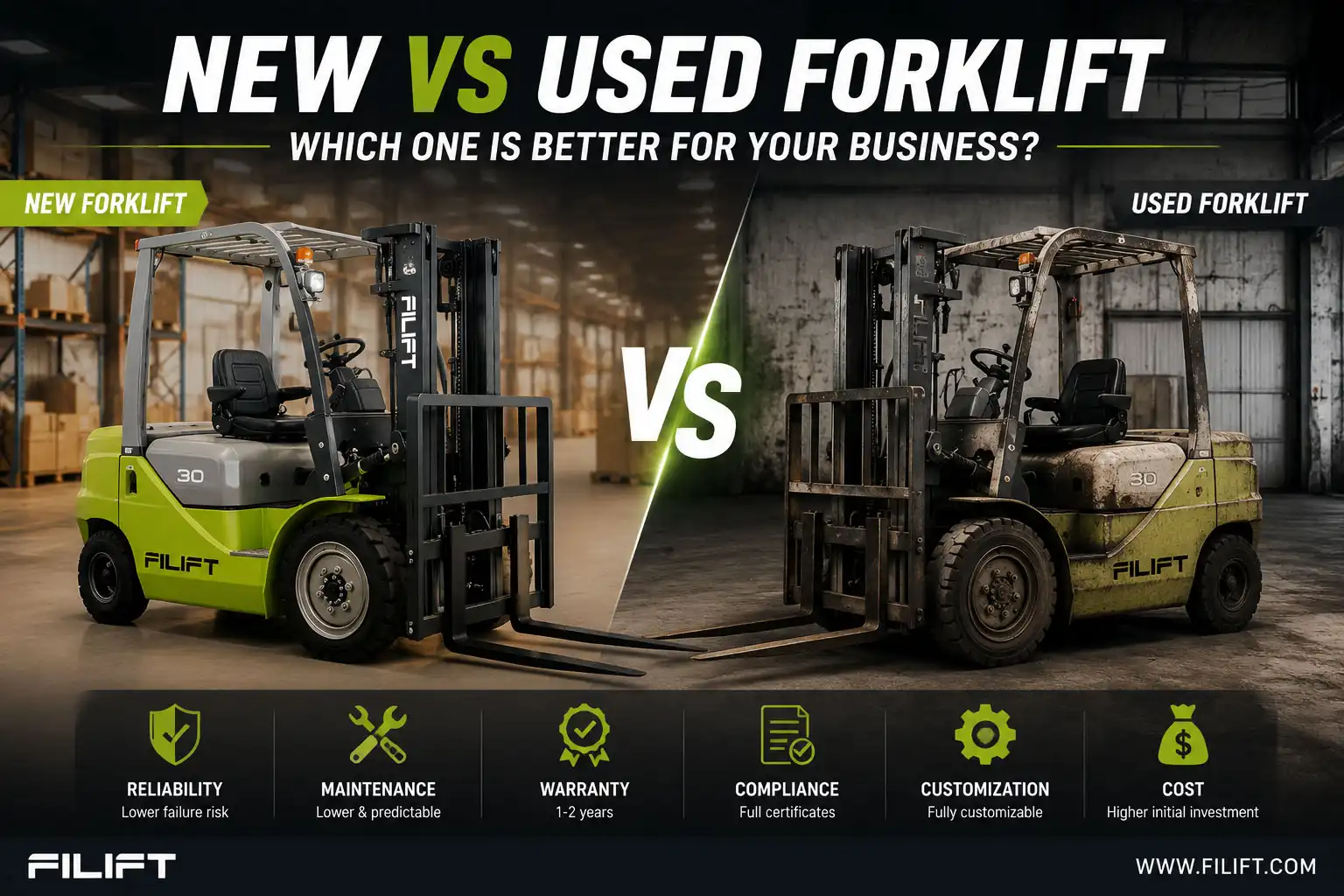
New vs Used Forklift: Which One Is Better for Your Business?
When purchasing a forklift, many buyers face the same question: Should I buy a new forklift or a used forklift?
The answer depends on several factors, including operating hours, workload intensity, budget, maintenance capability, and acceptable downtime risk.
A used forklift may have a lower purchase price, while a new forklift offers better reliability, longer service life, and lower operational risks.
The right choice is not always the cheapest option — it is the one that provides the best total cost of ownership (TCO) for your business.
While purchase price is often the first factor buyers consider, it should never be the only one. A lower-priced forklift may end up costing more over its lifetime due to repairs, downtime, and maintenance.
If you're still comparing forklift prices by type and capacity, you may also like our guide: How Much Does a Forklift Cost? Complete Price Guide by Type and Capacity.
New vs Used Forklift: Quick Comparison
| Comparison | New Forklift | Quality Used Forklift |
| Daily operating hours | More than 6 hours, heavy-duty operation | Less than 4 hours, light to medium operation |
| Recommended usage period | 3+ years long-term use | 1–2 years temporary use |
| Purchase budget | Higher | 40%–70% lower |
| Maintenance cost | Lower and predictable | Higher and less predictable |
| Breakdown risk | Low | Medium to high |
| Warranty | Usually 1–2 years | Usually 3 months–12 months (depends on supplier) |
| Import requirements | Easier with complete documents | May face restrictions |
| Customization | Fully customizable | Limited to available units |
| Technology | Latest features and safety systems | Older technology |
New Forklift: When Should You Choose a New Machine?
A new forklift is usually the better choice for companies that need reliable equipment for long-term and intensive operations.
A new forklift is suitable for:
1. Heavy daily operation and multiple shifts
If your forklift operates more than 6 hours per day, handles heavy loads, or runs multiple shifts, equipment reliability becomes critical.
Unexpected breakdowns can lead to:
·Production delays
·Additional labor costs
·Missed delivery schedules
·Emergency repair expenses
For high-intensity operations, a new forklift can reduce the risk of costly downtime.
2. Long-term ownership (3 years or more)
If you plan to use the forklift for 3–5 years or longer, buying new is usually more economical.
Although the initial investment is higher, a new forklift provides:
·Longer service life
·Lower repair frequency
·More predictable maintenance costs
·Better resale value
When calculating the total cost of ownership, the purchase price is only one part of the cost.
3. Need for customized configurations
New forklifts allow customers to choose configurations based on their working conditions, such as:
·Special lifting heights
·Different mast types
·Forklift attachments (such as side shifters and fork positioners)
·Lithium battery systems
·Low-emission engines (such as Euro 5 models)
This is especially important for warehouses, ports, manufacturing plants, and special working environments.
4. No professional maintenance team
For companies without experienced mechanics, a new forklift is easier to manage.
Benefits include:
·Factory warranty support
·Lower failure rates during the first years
·Easier access to technical support
·Original spare parts availability
Advantages of New Forklifts
✅ Lower failure risk
New forklifts usually have fewer mechanical problems during the first years of operation.
✅ Warranty protection
Most manufacturers provide warranty coverage, reducing unexpected repair costs.
✅ Better fuel or energy efficiency
Modern forklifts offer improved:
·Fuel efficiency
·Battery performance
·Hydraulic efficiency
This helps reduce long-term operating costs.
✅ Latest safety and productivity technologies
New forklifts can be equipped with:
·Safety systems
·Energy-saving technologies
·Operator protection features
·Productivity improvements
Disadvantages of New Forklifts
❌ Higher initial investment
The purchase price is significantly higher compared with used equipment.
❌ Faster depreciation in the first years
A new forklift loses more value during the first few years after purchase.
However, for businesses using forklifts intensively, the lower maintenance cost and reduced downtime often compensate for the initial depreciation.
Used Forklift: When Should You Choose a Used Machine?
A used forklift can be a practical choice for businesses with limited budgets or temporary operating needs.
However, buyers should carefully evaluate the machine condition and future maintenance risks.
A used forklift is suitable for:
1. Short-term projects with light operation
Used forklifts are suitable when:
·The project lasts only 1–2 years
·Daily operation is less than 4 hours
·Loads are light or medium
·Equipment utilization is relatively low
2. Backup or temporary equipment
A used forklift can work well as:
·A backup machine
·Seasonal equipment
·Temporary replacement equipment
For these applications, a lower purchase cost may be more important than maximum reliability.
3. Companies with maintenance capability
Used forklifts are more suitable for companies that have:
·Experienced technicians
·Local spare parts suppliers
·Ability to repair equipment independently
Advantages of Used Forklifts
✅ Lower purchase cost
A used forklift usually costs around 30%–60% of the price of a new forklift, depending on age, brand, and condition.
✅ Lower depreciation
Since the biggest depreciation has already occurred, a well-maintained used forklift may retain its value better when resold.
Disadvantages and Risks of Used Forklifts
❌Import and compliance risks
When importing used forklifts, some countries have strict requirements regarding:
·Emission standards
·Safety certificates
·Machine age restrictions
·Documentation requirements
Older forklifts may face difficulties during customs clearance.
❌Uncertain machine condition
The biggest challenge with used forklifts is that the actual condition is often difficult to verify.
Common problems include:
·Adjusted operating hours
·Hidden accident damage
·Worn-out hydraulic systems
·Mast deformation
·Rebuilt or mixed-component machines
A forklift that looks cheap initially may become expensive after purchase.
❌Higher maintenance uncertainty
Used forklifts usually have:
·No factory warranty
·Higher failure probability
·More difficult spare parts sourcing
Major repairs may involve:
·Engine overhaul
·Transmission repair
·Hydraulic system replacement
·Electrical system troubleshooting
For overseas buyers, long repair cycles and unavailable spare parts can create significant downtime.
❌Limited customization options
Unlike new forklifts, used machines are usually sold with existing configurations.
Buyers normally cannot customize:
·Mast height
·Attachments
·Tire type
·Battery system
·Safety options
Final Recommendation: Which Forklift Should You Buy?
There is no universal answer between a new forklift and a used forklift.
Choose a new forklift if:
·Your forklift is a key part of daily operations
·Downtime will cause financial losses
·You need long-term reliability
·You require customized configurations
Choose a used forklift if:
·Your budget is limited
·The machine is used occasionally
·The project is temporary
·You have strong maintenance capability
For most businesses that depend on forklifts every day, investing in a reliable new forklift often provides better value through lower downtime, lower maintenance risk, and higher productivity over the equipment's lifetime.