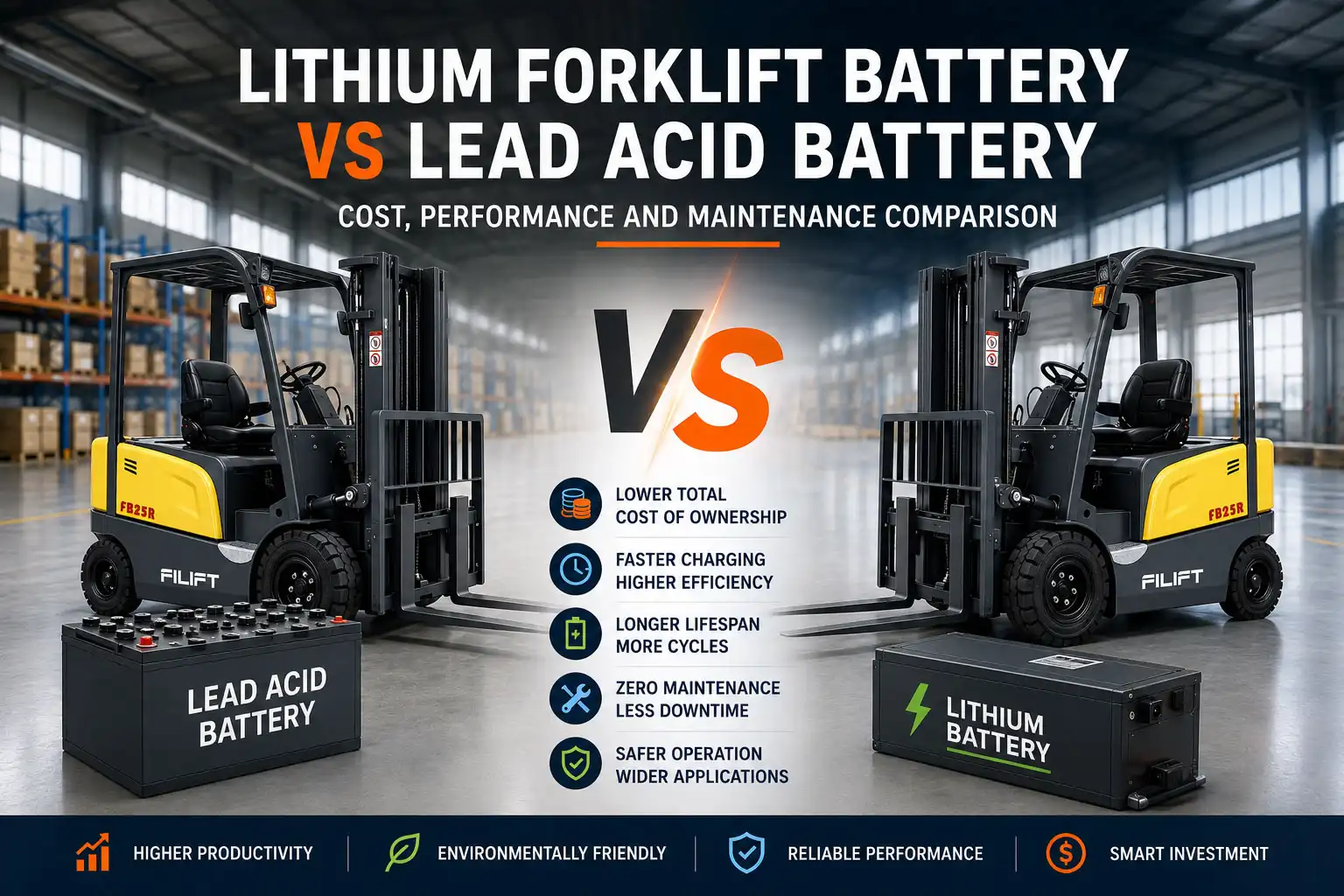
Lithium Forklift Battery vs Lead Acid Battery: Complete Cost, Performance and Maintenance Comparison
In modern warehouses, manufacturing facilities, and logistics operations, electric forklifts have become an increasingly popular alternative to diesel forklifts. As the core power source of electric forklifts, the battery directly affects operating efficiency, total ownership cost, and equipment reliability.
Currently, two major battery technologies dominate the forklift market: lithium-ion batteries (mainly lithium iron phosphate batteries, LiFePO4) and traditional lead-acid batteries.
When purchasing or upgrading electric forklifts, many companies face the same question:
Should they choose the lower upfront cost of lead-acid batteries or invest in lithium batteries for better long-term performance?
Many users only focus on the initial purchase price while overlooking long-term operating costs, productivity differences, and maintenance requirements. Choosing the wrong battery technology can lead to higher operating expenses and reduced equipment efficiency.
This article provides a comprehensive comparison of lithium forklift batteries vs lead-acid forklift batteries from three key perspectives: Total cost of ownership; Operating performance; Maintenance requirements
Helping businesses select the most suitable battery solution for their specific working conditions.
1. Total Cost of Ownership Comparison: Lower Initial Cost vs Long-Term Savings
Cost is one of the most important factors when selecting forklift batteries.
The main difference between lithium and lead-acid batteries is:
·Lead-acid batteries: Lower initial investment but higher long-term operating costs
·Lithium batteries: Higher upfront cost but lower total cost of ownership
When calculated over a 5-year operating period, the cost difference can become significant.
1.1 Initial Purchase Cost
Lead-acid batteries have been widely used in forklifts for decades due to their mature manufacturing process and relatively low material cost.
For the same voltage and capacity, a lead-acid battery usually costs significantly less than a lithium battery. This makes lead-acid forklifts attractive for companies with limited budgets, low utilization rates, or occasional material handling needs.
Lithium forklift batteries use advanced lithium iron phosphate cells combined with an intelligent Battery Management System (BMS). The additional battery management technology, safety systems, and manufacturing requirements result in a higher initial purchase price.
However, the higher upfront investment can often be recovered through lower energy consumption, reduced maintenance, and longer battery life.
In addition, lithium batteries may require additional transportation procedures due to lithium battery shipping regulations, which can increase logistics costs compared with traditional lead-acid batteries.
1.2 Battery Replacement and Service Life Costs
Battery cycle life is one of the most important factors affecting long-term costs.
Under normal operating conditions:
·Lead-acid forklift batteries typically provide around 1,000-2,000 charging cycles, depending on usage and maintenance conditions.
·Lithium iron phosphate forklift batteries can generally achieve 3,000-5,000+ charging cycles, with high-quality systems reaching even longer service life.
For high-frequency operations such as warehouses, factories, and distribution centers running multiple shifts, lead-acid batteries may require replacement several times during the equipment lifetime.
Lithium batteries, with their significantly longer cycle life, can reduce replacement frequency and avoid the high costs associated with battery replacement and downtime.
1.3 Energy Consumption Cost
Lithium batteries provide higher charging efficiency compared with lead-acid batteries.
Typical energy efficiency:
·Lead-acid battery system: approximately 60%-70%
·Lithium battery system: approximately 90% or higher
Because less electrical energy is lost during charging, lithium forklifts can significantly reduce electricity consumption over thousands of charging cycles.
For companies operating large forklift fleets, the accumulated energy savings can become a substantial part of long-term cost reduction.
1.4 Labor and Maintenance Costs
Lead-acid batteries require regular maintenance, including:
·Checking electrolyte levels
·Adding distilled water
·Cleaning acid residue
·Performing equalization charging
·Inspecting battery condition
These maintenance tasks require additional labor and management time.
Lithium forklift batteries are designed as maintenance-free systems. They do not require water refilling, acid cleaning, or regular equalization charging, which greatly reduces daily maintenance workload and labor costs.
1.5 5-Year Total Cost Comparison Example
3 Ton Electric Forklift | 40 kWh Battery | 5 Years Operation
Assumptions:
·300 working days/year
·1,500 charging cycles over 5 years
·Electricity cost: $0.20/kWh
·Lead-acid energy efficiency: 65%
·Lithium battery efficiency: 90%
·One lead-acid battery replacement required during 5 years
| Cost Item | Lead Acid Forklift | Lithium Forklift |
| Initial forklift price | $13,800 | $17,800 |
| Battery energy cost (1,500 cycles) | $18,462 | $13,582 |
| Battery replacement | $3,731 | $0 |
| Battery maintenance | $3,000 | $0 |
| Total 5-year operating cost | $38,993 | $31,382 |
Although lithium forklifts require a higher initial investment, the total 5-year operating cost can be more than 20% lower compared with lead-acid forklifts.
This demonstrates why more companies are choosing lithium battery forklifts for long-term industrial operations.
2. Operating Performance Comparison: Efficiency, Productivity and Reliability
Battery performance directly affects forklift productivity, working efficiency, and operational reliability.
For companies operating forklifts in multi-shift warehouses, manufacturing plants, and distribution centers, battery performance differences can directly impact daily production efficiency.
2.1 Charging Speed and Operational Flexibility
Charging time is one of the biggest differences between lithium and lead-acid forklift batteries.
Traditional lead-acid batteries usually require:
·8-12 hours for a full charge
·Dedicated charging areas
·Long charging downtime
In addition, lead-acid batteries generally need to be charged according to strict procedures. Frequent partial charging can reduce battery performance and shorten service life. During high-intensity operations, companies often need to prepare additional spare batteries and battery-changing equipment to support multiple shifts, increasing investment and management complexity.
Lithium forklift batteries provide much greater charging flexibility.
Advantages include:
·Fast charging capability
·Opportunity charging during breaks or shift changes
·Better support for multi-shift operations
A lithium forklift battery can typically be fully charged within 2-3 hours, and short charging periods can effectively extend operating time without interrupting workflow.
This makes lithium forklifts particularly suitable for warehouses and factories requiring continuous operation.
2.2 Runtime and Power Consistency
Lead-acid batteries experience noticeable voltage decline during discharge.
As battery power decreases:
·Forklift lifting speed may become slower
·Driving performance may decrease
·Heavy-load operations become less efficient
This means forklift performance may vary significantly between the beginning and end of a working shift.
Lithium iron phosphate batteries provide more stable voltage output throughout the discharge cycle.
Benefits include:
·Consistent lifting performance
·Stable driving power
·Better performance under heavy loads
·More predictable operating time
For applications involving frequent loading, unloading, and high utilization rates, lithium batteries help maintain consistent productivity throughout the working day.
2.3 Working Environment Adaptability and Safety
Battery technology also affects where electric forklifts can be used.
Traditional flooded lead-acid batteries require regular maintenance and may produce acid mist during charging. They also involve risks related to electrolyte leakage and corrosion if not properly managed.
Therefore, they are generally less suitable for highly sensitive environments requiring strict cleanliness standards.
Lithium forklift batteries offer several advantages:
·Fully sealed battery design
·No electrolyte leakage
·No acid mist during operation
·Low maintenance requirements
With an integrated Battery Management System (BMS), lithium batteries can continuously monitor:
·Overcharging
·Over-discharging
·Over-temperature
·Short circuits
·Abnormal operating conditions
This makes lithium forklifts suitable for a wider range of applications, including:
·Food and beverage facilities
·Pharmaceutical warehouses
·Cold storage operations
·Electronics manufacturing
·Clean production environments
2.4 Battery Size, Weight and Space Utilization
Battery design also affects forklift structure and warehouse efficiency.
Traditional lead-acid batteries are relatively large and heavy, requiring significant battery space inside the forklift.
Lithium batteries provide:
·Higher energy density
·More compact battery design
·Greater flexibility in forklift design
The smaller battery footprint allows manufacturers to optimize forklift layouts and provides advantages in applications where space efficiency is important, such as narrow aisles and high-density warehouses.
3. Maintenance Comparison: Labor Requirements and Operating Reliability
Maintenance requirements directly influence equipment availability and long-term operating costs.
The difference between lithium and lead-acid batteries is significant.
3.1 Lead Acid Battery: Higher Maintenance Requirements
Traditional lead-acid batteries require regular maintenance procedures, including:
·Checking electrolyte levels
·Adding distilled water
·Cleaning corrosion and acid residue
·Performing equalization charging
·Inspecting battery terminals
Without proper maintenance, lead-acid batteries may suffer from:
·Sulfation
·Reduced capacity
·Shortened service life
·Performance degradation
For companies operating large forklift fleets, these maintenance activities require additional labor and management resources.
3.2 Lithium Forklift Battery: Maintenance-Free Operation
Lithium forklift batteries are designed for low-maintenance operation.
Unlike lead-acid batteries, they do not require:
·Water refilling
·Acid cleaning
·Equalization charging
·Frequent manual inspections
Daily operation mainly requires basic checks of electrical connections and system status.
The reduced maintenance workload helps companies:
·Lower labor costs
·Reduce equipment downtime
·Improve forklift availability
4. Lithium Forklift Battery vs Lead Acid Battery: Key Comparison Table
| Comparison | Lead Acid Forklift Battery | Lithium Forklift Battery |
| Initial purchase cost | Lower upfront investment | Higher initial investment |
| Battery cycle life | 1,000-2,000 cycles | 3,000-5,000+ cycles |
| Charging time | 8-12 hours | Around 2-3 hours |
| Charging method | Requires full charging cycles | Supports opportunity charging |
| Energy efficiency | Approximately 60%-70% | 90%+ |
| Daily maintenance | Requires watering and cleaning | Maintenance-free |
| Power output | Voltage drops during discharge | Stable power output |
| Multi-shift operation | Usually requires spare batteries | Suitable for continuous operation |
| Battery replacement frequency | Higher | Much lower |
| Clean environment suitability | Limited for some applications | Suitable for food, pharmaceutical and electronics industries |
| Total ownership cost | Higher over long-term operation | 20% lower over long-term operation |
5. How to Choose Between Lithium and Lead Acid Forklift Batteries?
There is no single battery solution suitable for every company.
The right choice depends on operating hours, working environment, and long-term business goals.
Choose Lead Acid Forklift Batteries If:
Lead-acid forklifts may still be a practical choice for:
·Low-frequency operations
·Single-shift applications
·Daily working time below 4 hours
·Temporary material handling tasks
·Companies with limited initial investment budgets
For simple applications with low utilization, the lower purchase price can be attractive.
Choose Lithium Forklift Batteries If:
Lithium forklifts are recommended for:
·Two-shift or three-shift operations
·High-frequency material handling
·Large warehouses and distribution centers
·Food and pharmaceutical industries
·Cold storage facilities
·Clean manufacturing environments
·Companies focusing on long-term operating cost reduction
For businesses seeking higher productivity, lower maintenance, and better equipment utilization, lithium battery forklifts usually provide greater long-term value.
6. Conclusion: Lithium vs Lead Acid Forklift Battery
When selecting forklift batteries, the decision should not be based only on the initial purchase price.
The more important factors are:
·Total cost of ownership
·Productivity requirements
·Maintenance workload
·Operating environment
·Expected equipment lifespan
Lead-acid batteries remain a cost-effective solution for low-intensity applications where initial investment is the primary concern.
However, for modern warehouses, factories, and logistics operations, lithium forklift batteries provide significant advantages through:
·Longer service life
·Faster charging
·Higher energy efficiency
·Lower maintenance requirements
·More stable performance
·Better environmental adaptability
Although lithium forklifts require a higher upfront investment, they can deliver lower operating costs and higher productivity over the equipment lifecycle.
For companies looking to improve efficiency and reduce long-term operating expenses, lithium battery forklifts represent a reliable and future-oriented solution for industrial material handling.
Looking for the Right Lithium Forklift Solution?
FILIFT provides electric forklift solutions equipped with advanced lithium battery technology for warehouses, factories, and logistics applications worldwide.
Whether you need a standard electric forklift or a customized lithium battery forklift solution, our team can help you select the right equipment based on your working conditions and operational requirements.