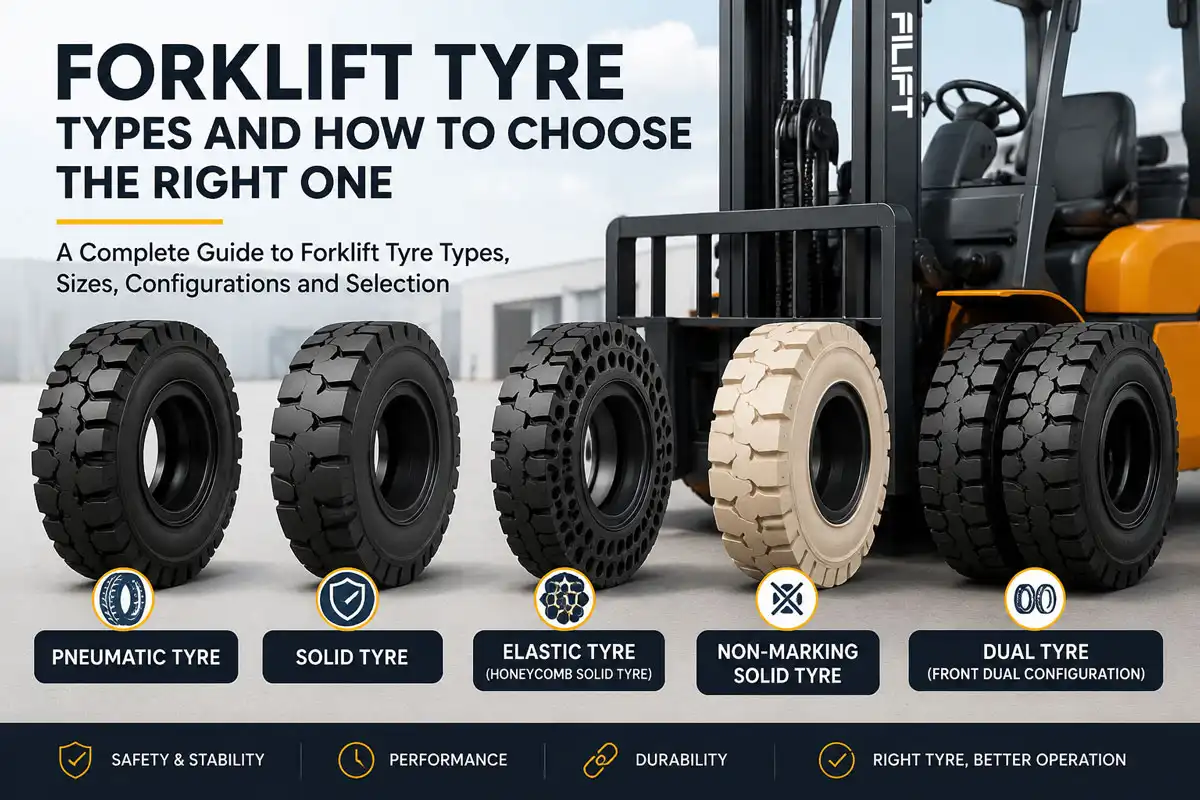
Forklift Tyre Types and Selection Guide
Forklift tyres play a vital role in stability, safety, and overall performance. Choosing the right tyre depends on the working environment, floor condition, and load requirements.
This guide introduces four main types of forklift tyres, their advantages and disadvantages, suitable applications, and typical tyre sizes for different forklift capacities.
1.Main Types of Forklift Tyres
1.1 Pneumatic Tyres
Pneumatic tyres are similar to car tyres, made of rubber layers and filled with air to support the load.
Advantages: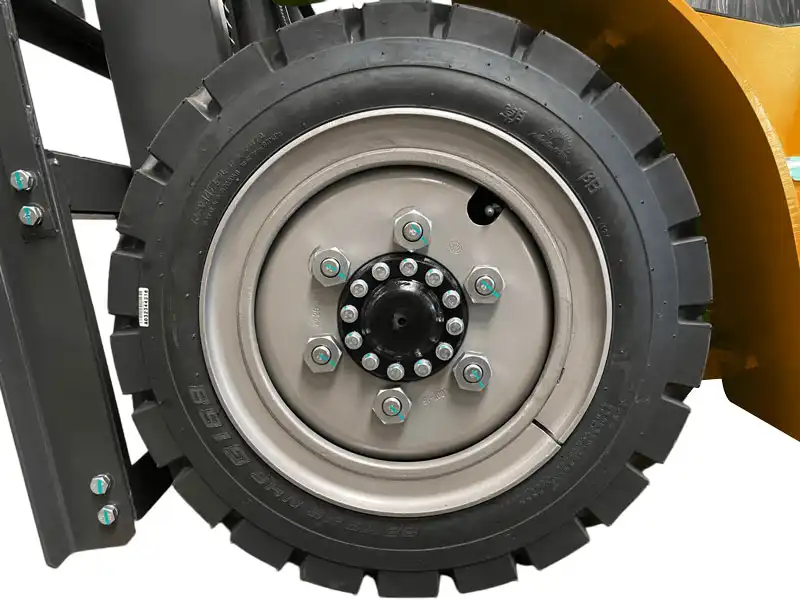
·Excellent shock absorption and driving comfort
·Suitable for uneven outdoor surfaces
·Lower initial cost
Disadvantages:
·Prone to punctures and air leaks
·Requires regular air pressure checks
·Shorter service life
Typical Applications: Outdoor operations, construction sites, ports, or rough surfaces.
Average Lifespan: 1,000–1,500 hours.
1.2 Solid Tyres
Solid tyres are made entirely of rubber or composite material and do not require air.
Advantages: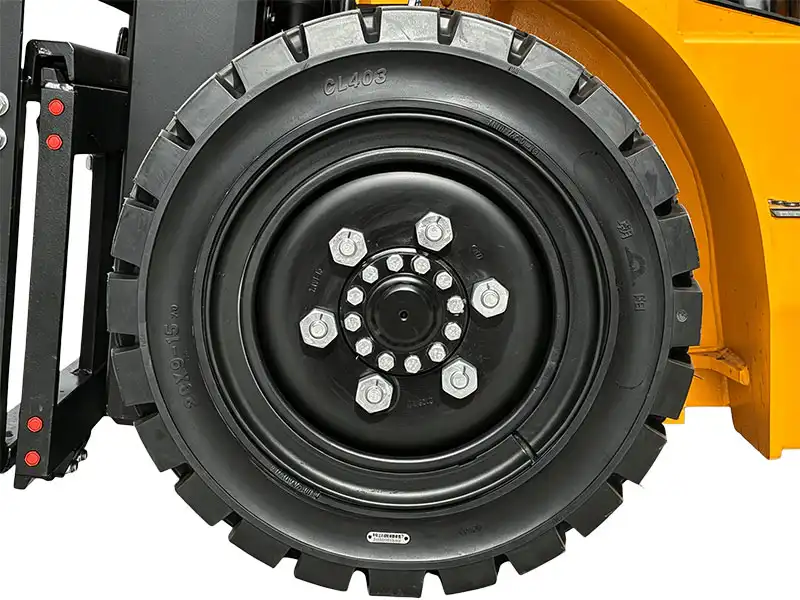
·Puncture-proof and highly durable
·Long service life and low maintenance
·High load capacity
Disadvantages:
·Poor shock absorption and comfort
·Requires flat and smooth ground
·Heavier, resulting in slightly higher energy consumption
Typical Applications: Indoor warehouses, factories, and smooth concrete floors.
Average Lifespan: 2,000–4,000 hours.
1.3 Cushion Solid Tyres (Elastic/Honeycomb Tyres)
Cushion solid tyres are an improved version of standard solid tyres.They feature holes or honeycomb structures on the sidewall, providing elasticity and vibration absorption.
Advantages: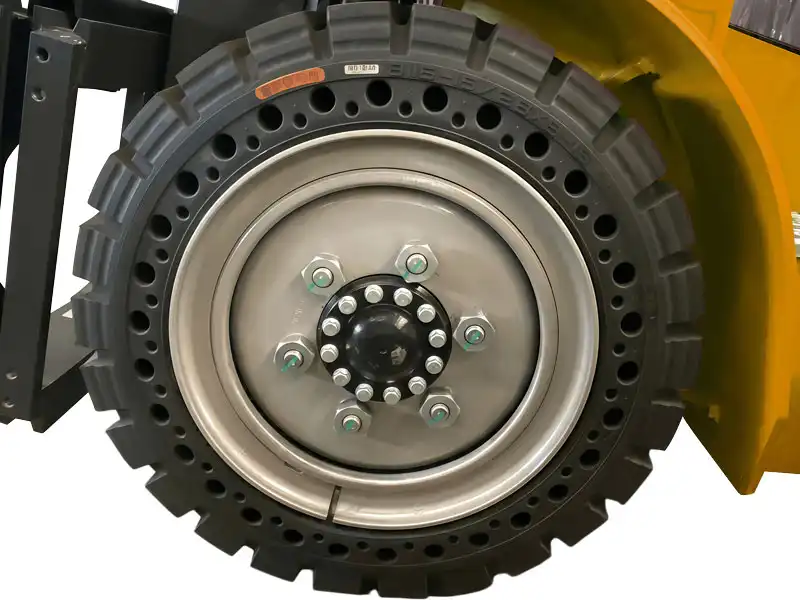
·Better shock absorption and comfort
·Puncture-proof and low maintenance
·Improved heat dissipation
·Smoother operation on uneven floors
Disadvantages:
·More expensive than standard solid tyres
·Not ideal for heavy-duty
Typical Applications: Mixed indoor–outdoor surfaces, moderately uneven ground, or frequent operation.
Average Lifespan: 2,500–3,500 hours.
1.4 Non-marking Solid Tyres
Non-marking tyres are made from light-colored rubber compounds without carbon black, usually beige, grey, or off-white. They do not leave black marks on the floor.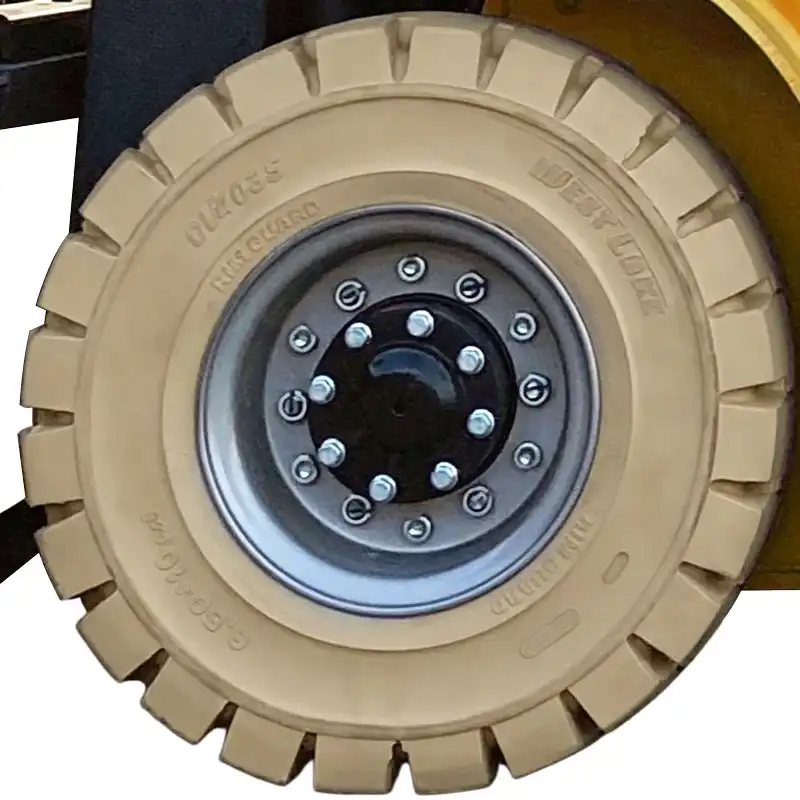
Advantages:
·Clean and non-staining, ideal for hygienic environments
·Optional anti-static or conductive versions
·Puncture-proof and safe
Disadvantages:
·Slightly lower wear and heat resistance
·Higher cost
·Slightly lower load capacity
Typical Applications: Food, pharmaceutical, electronics industries, cold storage, or clean rooms.
Average Lifespan: 2,000–3,000 hours.
2. Front Dual Tyre
For most 1–4 ton forklifts, the standard configuration includes four tyres in total:
·2 front tyres (drive wheels)
·2 rear tyres (steering wheels)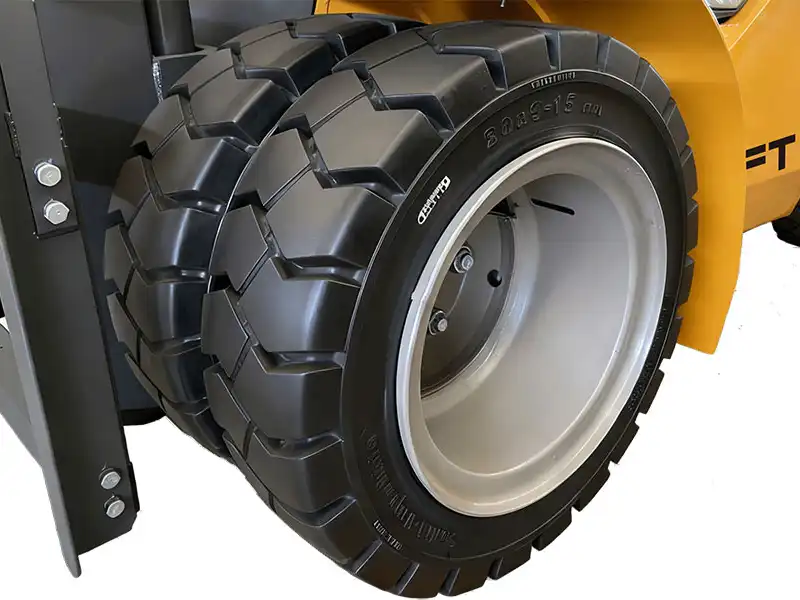
However, for applications involving:
·higher lifting heights
·heavier loads
·greater stability requirements
many forklifts are equipped with dual front tyres (double tyres on the front axle) to improve:
·load distribution
·driving stability
·operational safety
Dual front tyres provide a larger contact area with the ground, reducing tyre deformation and improving stability during high-load lifting operations.
For 5 ton forklifts and above, dual front tyres are typically standard equipment due to the much higher axle load and safety requirements.
3.Common Forklift Tyre Sizes and Weight Reference
|
Rated Capacity (t) |
Front Tyre Size | Rear Tyre Size |
Front Tyre Weight (kg) Pneumatic / Solid |
Rear Tyre Weight (kg) Pneumatic / Solid |
| 1.5 | 6.50-10 | 5.00-8 | 13 / 35 | 7 / 16 |
| 2.0/2.5 | 7.00-12 | 6.00-9 | 18 / 45 | 11 / 25 |
| 3.0/3.5 | 28×9-15 | 6.50-10 | 26 / 60 | 13 / 35 |
| 4.0 mini | 250-15 | 6.50-10 | 28 / 64 | 13 / 35 |
| 4.5 | 3.00-15 | 7.00-12 | 42 / 110 | 18 / 45 |
|
5.0 mini |
3.00-15 |
7.00-12 | 42 / 110 | 18 / 45 |
| 5.0 | 8.25-15 | 8.25-15 | 31 / 89 | 31 / 89 |
| 7.0 | 8.25-15 | 8.25-15 | 31 / 89 | 31 / 89 |
| 10.0 | 9.00-20 | 9.00-20 | 42 / 140 | 42 / 140 |
Note: The data above is for reference only. Actual specifications may vary depending on the manufacturer.
4. Tyre Selection Recommendations
|
Working Environment |
Recommended Tyre | Key Features |
| Rough outdoor surface | Pneumatic Tyre | Best shock absorption and traction |
| Flat indoor floor | Solid Tyre | Durable, long life, cost-effective |
| Mixed indoor/outdoor use | Cushion Solid Tyre | Balanced comfort and durability |
| Clean or hygienic area | Non-marking Tyre | No floor marks, anti-static options |
5.Summary
Selecting the right tyre depends on your working environment, load capacity, and maintenance preference. A proper choice can greatly improve forklift safety, comfort, and cost efficiency.