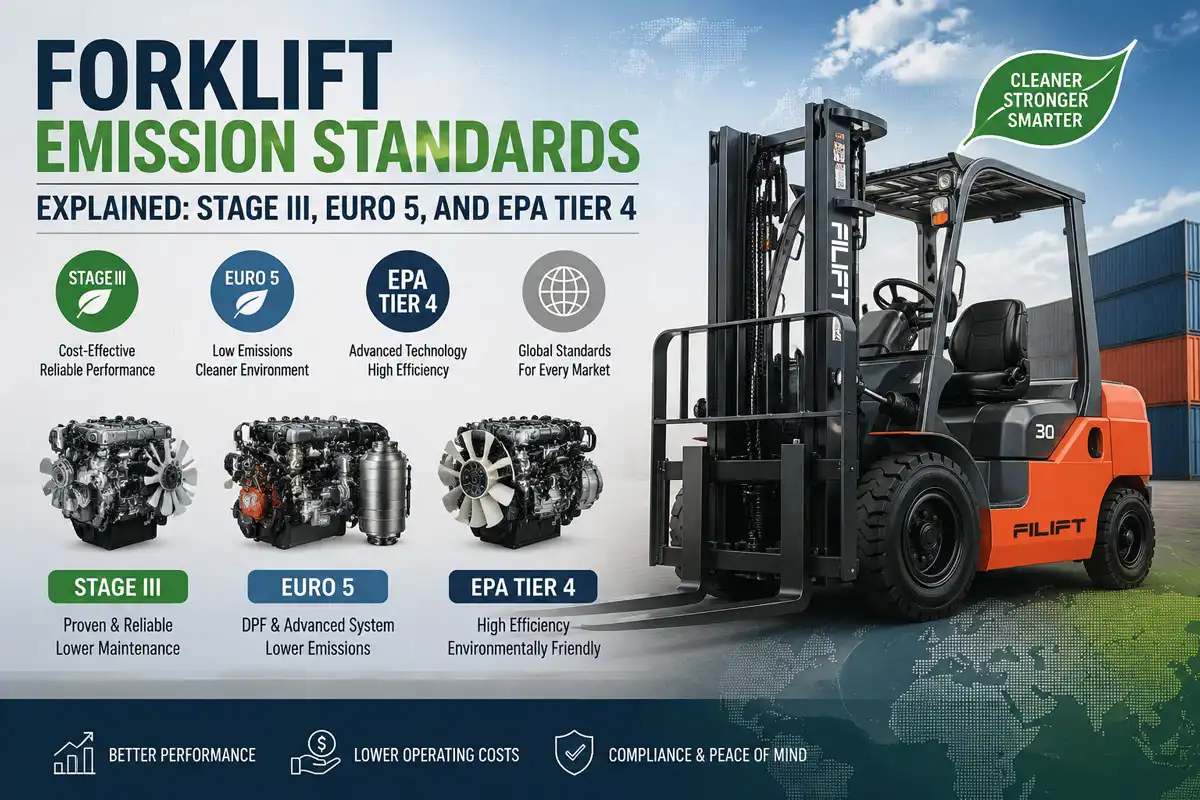
Forklift Emission Standards Explained: Euro 3, Euro 5, EPA Tier 4, and China Stage III
When purchasing an internal combustion forklift, engine emission standards are often as important as load capacity, lift height, and operating costs.
Different countries and regions enforce different environmental regulations. A forklift that can be legally sold in Africa may not be approved for use in Europe or the United States.
Understanding forklift emission standards can help you choose the right equipment, avoid import issues, and balance cost with environmental compliance.
In this guide, we explain the major forklift emission standards, the engines commonly used in each category, and the key differences between China Stage III, Euro 3 and Euro 5 forklifts.
What Are Forklift Emission Standards?
Forklift emission standards are regulations that limit the amount of pollutants produced by diesel or gasoline engines.
The main pollutants regulated include:
·Nitrogen Oxides (NOx)
·Particulate Matter (PM)
·Carbon Monoxide (CO)
·Hydrocarbons (HC)
As emission requirements become stricter, engines must adopt more advanced technologies to reduce harmful exhaust emissions.
Generally speaking:
·Higher emission standards = lower emissions
·More advanced technology = higher purchase cost
·More complex systems = increased maintenance requirements
Forklift Emission Requirements by Region
Emission regulations vary significantly across different markets.
| Region | Common Emission Standard |
| European Union | Stage V (Euro 5) |
| United Kingdom | Stage V |
| Turkey | Stage V |
| United States | EPA Tier 4 Final |
| Canada | EPA Tier 4 Final |
| Japan | Japanese Off-Road Emission Standards |
| South Korea | Tier 4 Equivalent |
| China | China Stage IV |
| Southeast Asia | Usually No Mandatory Requirement |
| Africa | Usually No Mandatory Requirement |
| Middle East | Usually No Mandatory Requirement |
Although many developing countries do not currently enforce strict emission regulations, low-emission equipment is becoming increasingly popular in ports, logistics centers, mining operations, and government projects.
Common Forklift Engine Emission Levels
China Stage II/Ⅲ Engines
Typical engines include:
·Xinchai C490/A495/A498
·Quanchai 490 Series
Key characteristics:
·Mechanical fuel injection
·Simple engine structure
·Easy maintenance
·Lower purchase cost
·Suitable for markets without strict emission regulations
Common export destinations:
·Africa
·Middle East
·Parts of Southeast Asia
China Stage Ⅱ/ III remains one of the most widely used emission levels for export diesel forklifts.
Euro 3 Engines
Typical engines include:
·Isuzu C240
·Isuzu 4JG2
·Mitsubishi S4S
·Mitsubishi S6S
These engines have been among the most widely used forklift engines worldwide for decades and are known for their durability, reliability, and ease of maintenance.
Key characteristics:
·Proven mechanical diesel engine design
·Excellent reliability in harsh working environments
·Strong global parts availability
·Simple maintenance and repair procedures
·Long service life
For many years, Isuzu and Mitsubishi Euro III engines were considered the benchmark power solutions for diesel forklifts and were commonly installed on Japanese, Chinese, and international forklift brands.
Although newer emission regulations have accelerated the adoption of Euro 5 engines, Euro III engines remain highly popular in Africa, the Middle East, Southeast Asia, and other markets where strict emission compliance is not required.
Common export destinations:
·Africa
·Middle East
·Southeast Asia
·Latin America
Many forklift users still regard the Isuzu C240, Isuzu 4JG2, Mitsubishi S4S, and Mitsubishi S6S as some of the most reliable forklift engines ever produced.
Euro 5 Engines
Typical engines include:
·Kubota V2403-CR-E5B
·Kubota V3307-CR-T-E5B
·Xinchai Euro 5 Series
Key characteristics:
·Electronic Common Rail (ECR) fuel injection
·ECU-controlled engine management
·Diesel Particulate Filter (DPF)
·Diesel Oxidation Catalyst (DOC)
·Significantly reduced emissions
Common applications:
·European Union countries
·Turkey
·High-end international markets
·Environmentally regulated industrial facilities
Is China Stage III Equivalent to Euro III?
This is a common question among forklift buyers.
In practice, China Stage II is often roughly compared to Euro II, while China Stage III is often roughly compared to Euro III.
| China Standard | Rough Equivalent |
| China Stage II | Euro 2 |
| China Stage III | Euro 3 |
| China Stage IV | Euro 4 / Early Euro 5 Level |
However, these standards are based on different testing procedures and regulatory frameworks.
Therefore, a China Stage III engine should not be considered officially certified as Euro III unless it has obtained the required certification.
Why Are Euro 5 Forklifts More Expensive?
Euro 5 forklifts typically cost significantly more than Stage III models.
Several factors contribute to the higher price.
Advanced Fuel Injection Systems
Euro 5 engines use:
·Electronic control units (ECU)
·High-pressure common rail systems
·Multiple sensors for engine management
These technologies improve fuel efficiency and reduce emissions.
Exhaust After-Treatment Systems
Most Euro 5 diesel forklifts include:
·DOC (Diesel Oxidation Catalyst)
·DPF (Diesel Particulate Filter)
These components remove harmful particles and pollutants before exhaust gases are released into the atmosphere.
Certification and Compliance Costs
Engine manufacturers must invest heavily in:
·Emission testing
·Product certification
·Regulatory compliance
These costs are ultimately reflected in the final equipment price.
China Stage III(Euro 3) vs Euro 5 Forklifts
| Feature | Stage III (Euro 3) | Euro 5 |
| Purchase Cost | Lower | Higher |
| Emissions | Moderate | Very Low |
| Fuel System | Mechanical or Basic Electronic | Electronic Common Rail |
| DPF System | Not Required | Required |
| Maintenance Complexity | Low | Higher |
| Suitable Markets | Developing Countries | Europe and Regulated Markets |
| Environmental Performance | Standard | Excellent |
For buyers operating in regions without strict emission regulations, Stage III and Euro 3 forklifts often provide the best balance between cost and performance.
For buyers targeting Europe or environmentally regulated industries, Euro 5 forklifts are generally required.
What Is a DPF System?
DPF stands for Diesel Particulate Filter.
It is one of the most important components in a Euro 5 diesel forklift.
The DPF captures soot and particulate matter generated during diesel combustion, preventing these pollutants from being released into the atmosphere.
Advantages of DPF
·Significantly lower particulate emissions
·Improved environmental compliance
·Meets modern emission regulations
Challenges of DPF
·Requires periodic regeneration
·Can become clogged during prolonged low-load operation
·Increases maintenance complexity
Understanding DPF maintenance is essential when operating Euro 5 forklifts.
Which Emission Standard Should You Choose?
Choose China Stage II/III or Euro 3 If:
·Your country has no mandatory emission requirements
·Purchase cost is a major concern
·Simple maintenance is preferred
·Fuel quality may be inconsistent
Choose Euro 5 If:
·Local regulations require it
·The forklift will be used in Europe or Turkey
·Environmental compliance is important
·Your customers require low-emission equipment
Selecting the appropriate emission standard can help reduce operating costs while ensuring compliance with local regulations.
Conclusion
Forklift emission standards continue to evolve as governments introduce stricter environmental regulations.
For most developing markets, Stage II and Stage III forklifts remain popular due to their affordability and simple maintenance. However, Euro 5 forklifts are becoming the preferred choice in regions where environmental compliance is mandatory.
Before purchasing a forklift, buyers should carefully review local regulations and select an emission level that balances compliance, operating costs, and long-term reliability.